The Challenge
Predicting the physical properties of materials like Tungsten Diselenide (WSe2) usually requires Density Functional Theory (DFT). While highly accurate, DFT is computationally extremely expensive, limiting simulations to small systems and short timescales. Classical force fields, on the other hand, are fast but often fail to capture the complex quantum mechanical interactions of 2D materials.
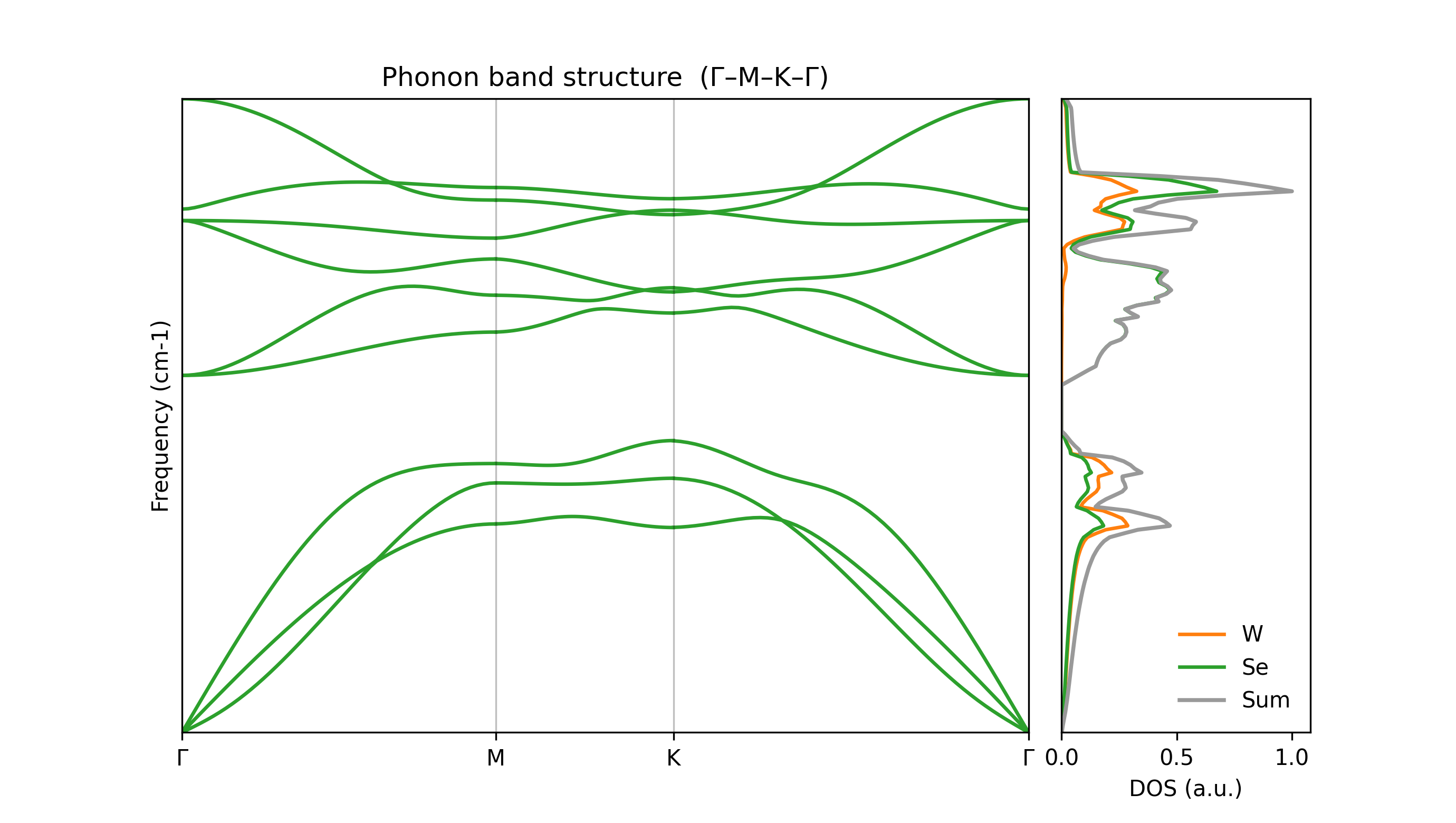
Ground-truth phonon band structure and Density of States (DOS) for pristine WSe2. These vibrational properties serve as the physical reference used to validate the machine learning model
The Solution
In my bachelor thesis, I implemented and trained a Machine Learning Force Field (MLFF) based on the MACE (Multi-Atomic Cluster Expansion) architecture.
- Data Generation: Curated a high-quality dataset of atomic configurations using ab-initio methods.
- Model Training: Utilized equivariant neural networks to map atomic environments to potential energy surfaces.
- Validation: Benchmarked the model against ground-truth DFT data to ensure high fidelity in force and energy predictions.
Key Results
- Efficiency: Achieved a speedup of several orders of magnitude compared to traditional DFT.
- Accuracy: Maintained “ab-initio” level precision (low MAE in energy/forces), enabling large-scale Molecular Dynamics (MD) simulations.
- Scalability: Demonstrated that the model can generalize to larger supercells that were previously unreachable.
- Scientific Insight: Successfully modeled defect-induced changes in the material’s vibrational spectrum, which is critical for semiconductor applications.
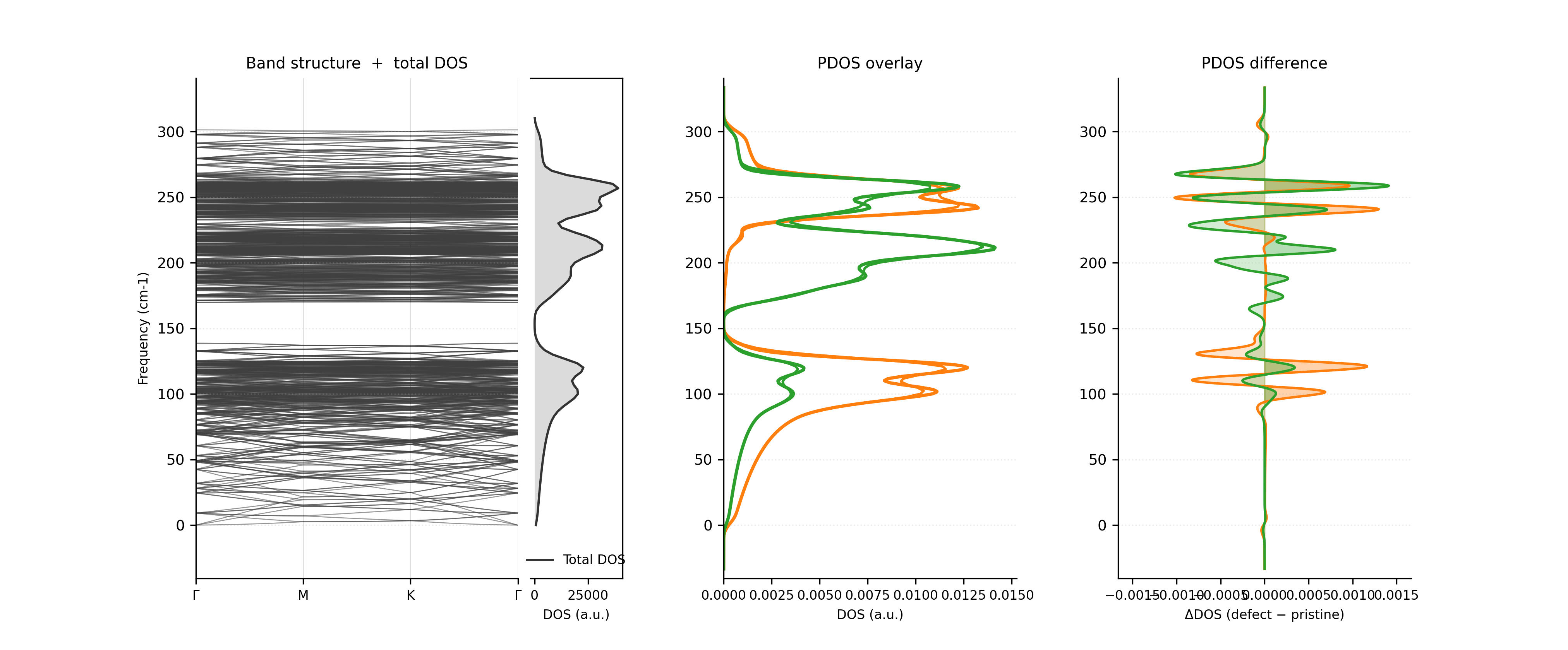
Comparison of phonon band structures and PDOS, demonstrating the emergence of localized vibrational modes and confirming the model’s consistency with first-principles theory.
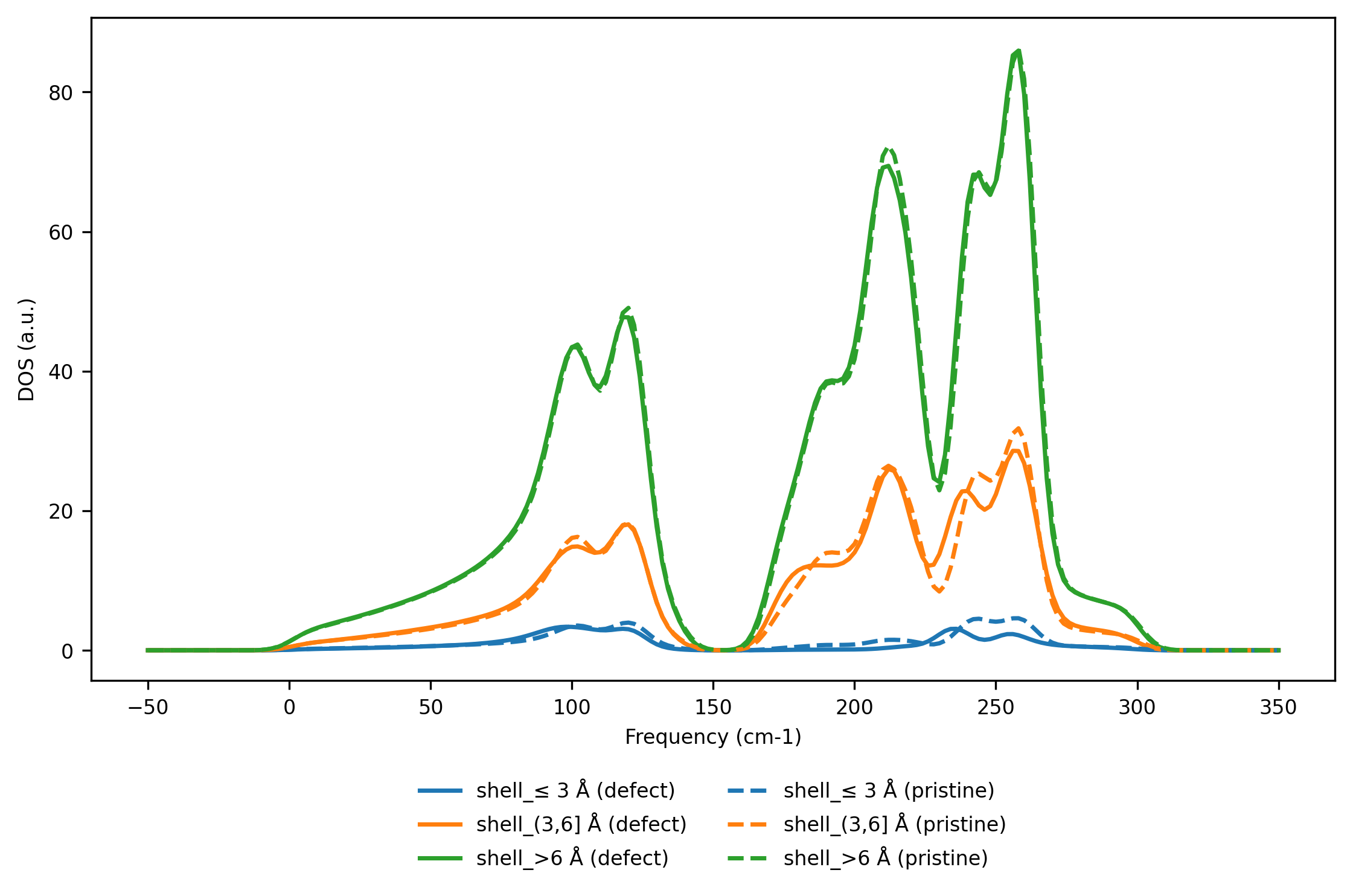
Radial Comparison between pristine and defective system, revealing how vibrational properties evolve with distance from the defect. This demonstrates the model’s ability to capture localized physical interactions.
Tech Stack
- Languages: Python
- ML Frameworks: PyTorch, MACE
- Simulation Tools: ASE, Phonopy
- Science: DFT, Solid State Physics, Phonon Analysis